 Incented
Conviction Voting
Understanding the stake-to-vote mechanism with rewards and slashing
In most voting systems, everyone's opinion counts the same - whether they spent five seconds or five hours evaluating. Incented flips this by asking: how confident are you?
When you vote, you stake tokens. The more you stake, the more weight your vote carries - but also the more you stand to win or lose. This is Conviction Voting.

The Basics
Stake to Vote
Instead of clicking a button, you put tokens on the line:
- Small stake → "I think this is good, but I'm not certain"
- Medium stake → "I'm fairly confident in this assessment"
- Large stake → "I've done my research and I'm willing to bet on it"
Your stake is both your voice and your skin in the game.
Vote FOR or AGAINST
For each submission, you pick a side:
- FOR → "This deserves to win" - you're backing it
- AGAINST → "This shouldn't win" - you're signaling it's not good enough
You can change your vote before voting ends, but you can't withdraw stake once it's placed.
How Winners Are Decided
When voting closes, the math is simple:
Net Votes = Total FOR Stakes − Total AGAINST Stakes
A submission with 1,000 tokens FOR and 400 tokens AGAINST has net votes of +600.
How those net votes translate to winners depends on the program:
- Top X → Highest net-voted submissions win (e.g., "top 5 win")
- Quorum → Any submission where FOR exceeds a threshold wins (e.g., "60% approval")
Were You Right?
After results are in, every vote gets classified:
| You voted... | Submission... | Result |
|---|---|---|
| FOR | Won | ✅ You were right |
| FOR | Lost | ❌ You were wrong |
| AGAINST | Lost | ✅ You were right |
| AGAINST | Won | ❌ You were wrong |
Notice: voting AGAINST a losing submission is just as "correct" as voting FOR a winner. Identifying what shouldn't win is valuable work too.
This is where the consequences kick in.
The Carrot and the Stick
This is where Incented gets its teeth. Every vote has consequences.
The Carrot: If You're Right
Being "right" works both ways:
- Vote FOR a submission that wins → You're right
- Vote AGAINST a submission that loses → You're also right
This is important: you can earn rewards by identifying bad submissions, not just good ones. Voting AGAINST something that doesn't deserve to win is just as valuable as voting FOR something that does.
When you're right, you earn from two pools:
1. Voting Pool - The program sets aside tokens specifically to reward voters. Your share is proportional to how much you staked compared to other correct voters.
2. Slash Pool - When incorrect voters get slashed, those tokens go to you. It's a bonus on top of your voting pool reward.
The formula:
Your Reward = (Your Stake / All Correct Stakes) × (Voting Pool + Total Slashed)Example: You staked 500 tokens and got it right. Total correct stakes were 5,000. The voting pool is 1,000 and 200 tokens were slashed from wrong voters.
Your reward: (500 / 5,000) × (1,000 + 200) = 120 tokens
The Stick: If You're Wrong
You lose a percentage of your stake. The program's slash percentage determines how much.
Your Loss = Your Stake × Slash PercentageExample: You staked 500 tokens with a 10% slash rate. You lose 50 tokens.
Those 50 tokens get redistributed to the people who got it right.
The slashed tokens don't disappear - they go to correct voters. Getting it wrong literally pays the people who got it right.
Putting It Together
Let's follow four voters through a real scenario.
The program: Top 2 winners, 1,000 token voting pool, 10% slash rate.
Three submissions: Project A, Project B, Project C.
The Votes
| Voter | Backs | Direction | Stake |
|---|---|---|---|
| Alice | Project A | FOR | 500 |
| Bob | Project A | AGAINST | 200 |
| Carol | Project B | FOR | 300 |
| Dave | Project C | FOR | 400 |
What Happened
Project A wins with net +300 (500 FOR − 200 AGAINST) Project B wins with net +300 Project C loses - didn't make top 2
Who Was Right?
- Alice ✅ - Backed A, which won
- Bob ❌ - Voted against A, but it won anyway
- Carol ✅ - Backed B, which won
- Dave ❌ - Backed C, which lost
The Math
Slashing: Bob loses 20 tokens (200 × 10%), Dave loses 40 tokens (400 × 10%). Total slashed: 60 tokens.
Correct stakes: Alice (500) + Carol (300) = 800 tokens total.
Rewards:
- Alice: (500/800) × 1,060 = 662.50 tokens
- Carol: (300/800) × 1,060 = 397.50 tokens
Alice staked more, so she gets a bigger share. Both walk away with more than they put in.
How to Think About Voting
Do your homework. The whole point of staking is to reward careful evaluation. Skim a submission and guess? You're gambling. Read it properly and you're making an informed bet.
Size your stakes to your confidence. Not sure about a submission? Stake less. Very confident? Stake more. Your stake should reflect how certain you are, not how much you want to win.
Spread your risk. Putting everything on one submission is high variance. Voting across multiple submissions with appropriate stake sizes is usually smarter.
For more on effective voting approaches, see Voting Strategies.
The Timeline
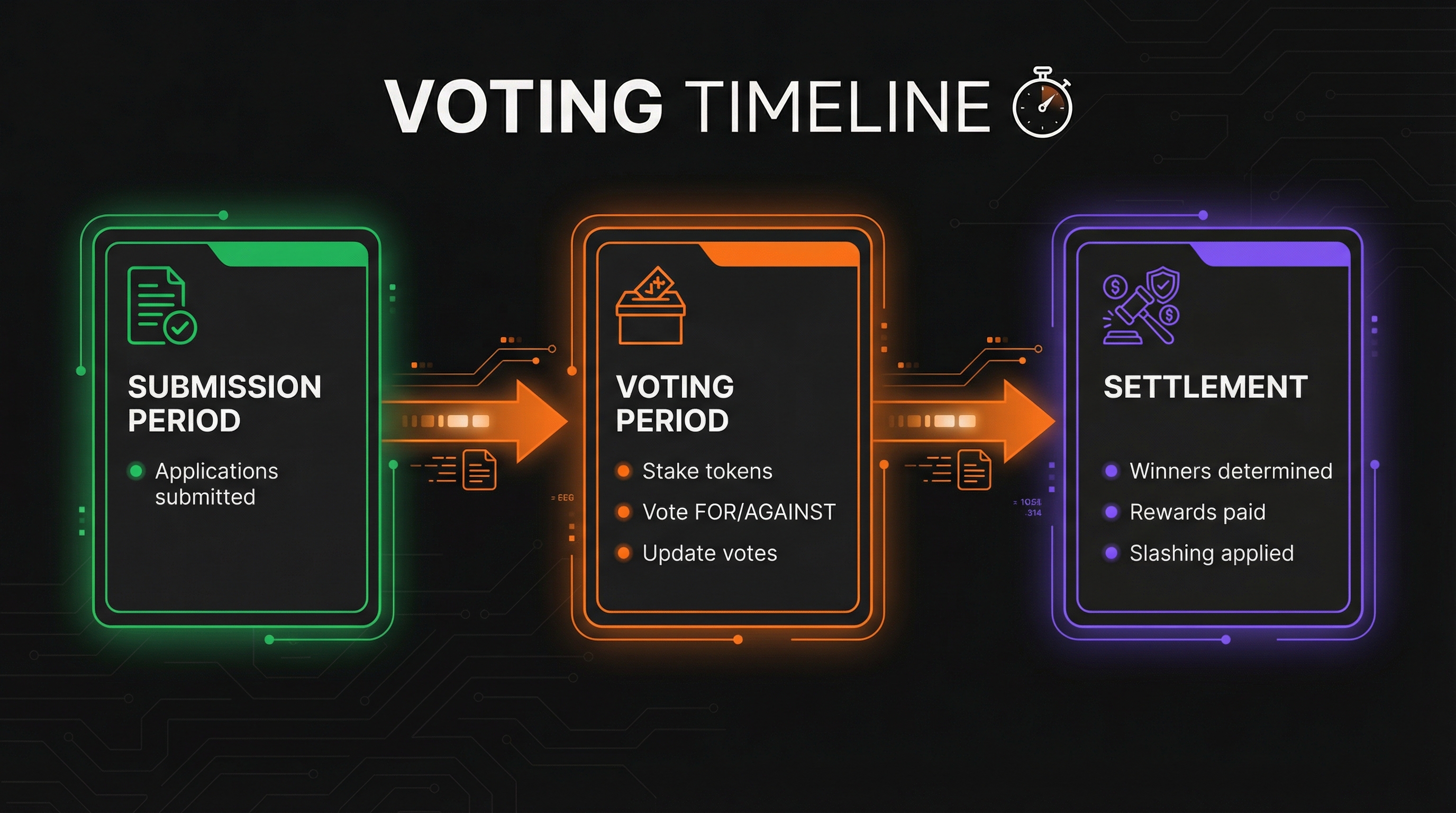
Edge Cases
Not every voting round goes smoothly. Here's what happens in unusual situations:
No Submissions Have Positive Net Votes
Scenario: A Top 1 program has two submissions. Submission A gets only AGAINST votes (-100 net). Submission B gets no votes (0 net).
Result: No winner. Both submissions are marked as failed.
To win, a submission must have strictly positive net votes (more FOR than AGAINST). Zero doesn't count. The award pool remains in the multisig for the program managers to handle.
Fewer Eligible Submissions Than Winner Slots
Scenario: A Top 5 program has ten submissions, but only three have positive net votes.
Result: Only three winners. The remaining two slots stay empty. Awards are distributed among the three winners based on the award type (Fixed, Split Equal, etc.).
Ties in Net Votes
Scenario: Two submissions both have +500 net votes, competing for the last winner slot.
Result: Ties are broken by unique voter count. The submission with more individual voters wins. If still tied, the earlier submission wins.
No Votes Cast At All
Scenario: A voting period ends with zero votes on any submission.
Result: All submissions are marked as failed. No awards distributed. No voting rewards or slashing occurs (there were no voters).
Quorum Met But Net Votes Negative
Scenario: A Quorum 60% program has a submission with 60 FOR votes and 50 AGAINST votes. That's 54.5% approval, but net votes are +10.
Result: This submission does not win. Quorum programs require both:
- Meeting the approval percentage threshold
- Having positive net votes
A submission that technically meets quorum but has equal or more AGAINST than FOR votes still fails.
Everyone Votes AGAINST
Scenario: All voters vote AGAINST on all submissions.
Result: No winners (all have negative net votes). All AGAINST voters are correct because the submissions they voted against did lose. They share the voting pool.
Edge cases are rare, but understanding them helps you make better voting decisions. When in doubt, the rule is simple: positive net votes are required to win.
The Bottom Line
- Your stake is your conviction - more tokens = stronger vote
- Right voters split the voting pool AND the slashed tokens
- Wrong voters lose a percentage of their stake
- The system rewards people who do the work to evaluate properly
Next: Incentive Programs - how programs are structured and run