 Incented
Tokens & Rewards
Understanding award pools, voting pools, and token distribution mechanics
Every program has money flowing to two groups: contributors who do the work, and voters who evaluate it. Understanding how these pools work helps you know what you're playing for.
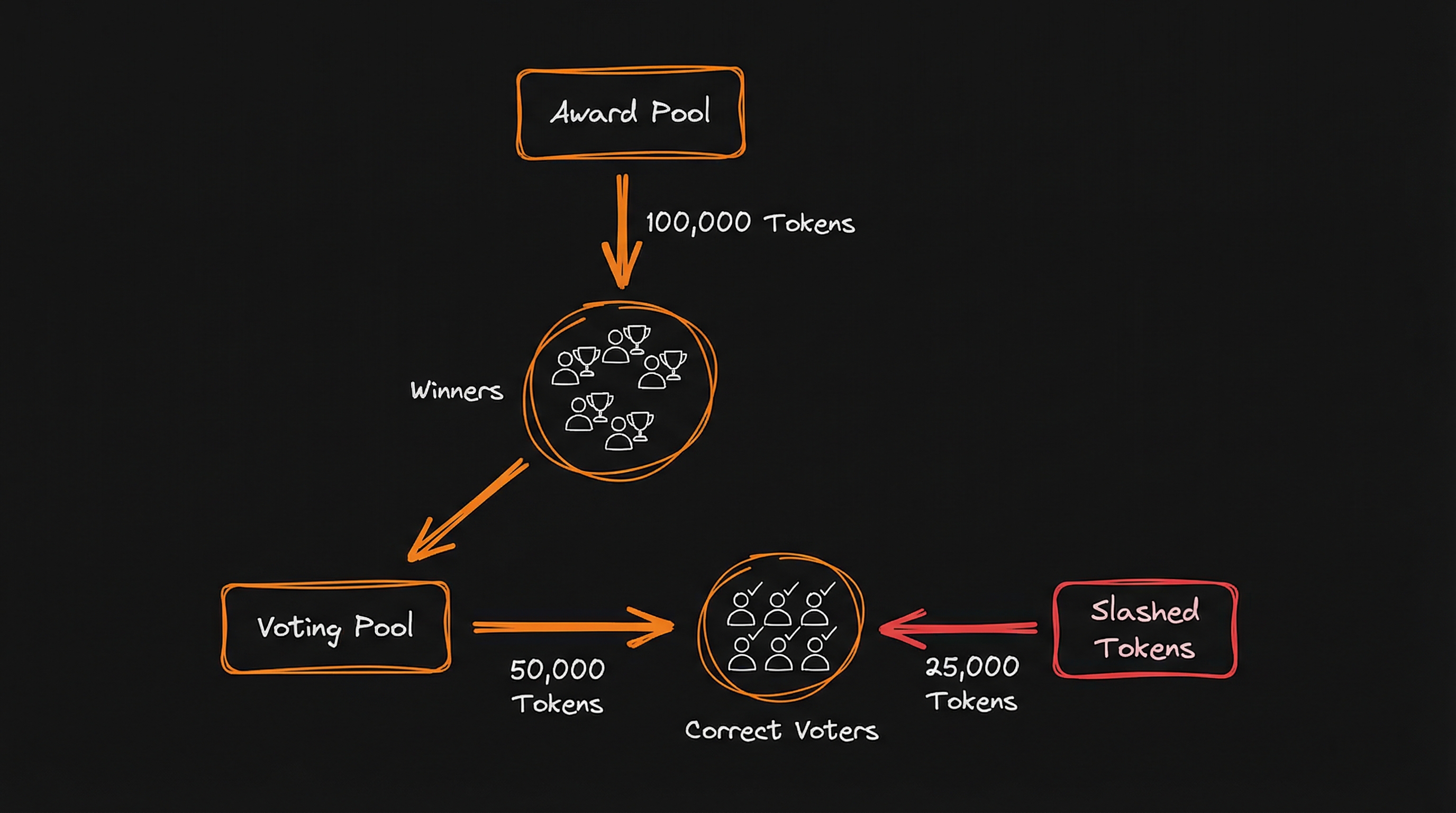
Two Pools, Two Purposes
Award Pool → Pays winning contributors. This is the award for work done, grant money, bounty payout, or prize fund, etc.
Voting Pool → Pays correct voters. This is the incentive for people to evaluate submissions thoughtfully.
These can use different tokens. A program might pay contributors in their native token but reward voters in stablecoins - or vice versa.
How Contributors Get Paid
The program's award type determines how the pool gets split among winners:
Fixed - Every winner gets the same amount, regardless of votes. "Top 5 each get 2,000 USDC."
Split Equal - Pool divided evenly among all winners. 10,000 USDC with 4 winners = 2,500 each.
Split Proportional - Higher-voted submissions get more. If you got 50% of the winning votes, you get 50% of the pool.
Milestone - Contributors propose deliverables with budgets. Funding releases as milestones are completed - useful for longer-term projects.
How Voters Get Paid
Correct voters earn from two sources (covered in detail in Conviction Voting):
- Voting Pool - Your share based on how much you staked vs. other correct voters
- Slash Pool - Tokens taken from incorrect voters, redistributed to you
The more you staked (and got right), the bigger your share.
Your stake comes back too. Rewards are on top of your original stake - you're not risking the principal, just the slash percentage if you're wrong.
| If you're... | You get back... |
|---|---|
| Right | Your stake + voting pool share + slash pool share |
| Wrong | Your stake minus the slash (e.g., 10% penalty) |
Multi-Cycle Programs
For recurring programs, you set pool amounts per cycle. The total you need to fund is per-cycle amounts times cycle count.
Example: 25,000 USDC award pool per cycle × 4 cycles = 100,000 USDC total to fund.
Each cycle settles independently. Winning cycle 1 doesn't affect cycle 2's pool.
What Tokens Can You Use?
Programs can use any token available on their chain:
EVM chains - USDC, ETH, or any ERC-20 token (including your own project token)
Solana - USDC, SOL, or any SPL token
Most programs use stablecoins like USDC for predictability, but governance tokens work well for voting rewards if you want to distribute ownership to engaged community members.
Make sure your wallet matches the program's chain. An EVM wallet won't work for Solana programs and vice versa.
How Settlement Works
When a cycle ends, the protocol calculates everyone's rewards and creates transactions:
- Awards for winning contributors
- Rewards for correct voters
- Stake returns for all voters (minus any slashing)
These transactions get queued to the program's multisig wallet. Once signers approve, tokens flow to recipients on-chain.
Quick Examples
Contributor wins with Split Equal: Award pool of 10,000 USDC, 4 winners → each gets 2,500 USDC
Voter gets it right: Staked 500 tokens, total correct stakes were 2,500, voting pool is 1,000, slashed pool is 200 → Gets (500/2,500) × 1,200 = 240 tokens reward, plus original 500 stake back = 740 total
Voter gets it wrong: Staked 1,000 tokens, 15% slash rate → loses 150 tokens, gets 850 back
The Summary
- Contributors compete for the award pool - how it's split depends on the award type
- Voters compete for the voting pool + slashed tokens - bigger stakes = bigger share
- Your stake comes back (minus slashing if you're wrong)
- Multi-cycle programs divide pools evenly across cycles
- Settlement queues transactions to multisig for final approval
Ready to participate?
- Program Managers - Create and fund programs
- Contributors - Submit applications
- Voters - Stake and vote